Thursday, 1 November 2012

Dismissal, confession, and pardon


Investigation and confession
The Pakistani government's blanket denials became untenable as evidence mounted of illicit nuclear weapons technology transfers. It opened an investigation into Khan's activities, arguing that even if there had been wrongdoing, it had occurred without the Government of Pakistan's knowledge or approval. But critics noted that virtually all of 

Khan's overseas travels, to Iran, Libya, North Korea, Niger, Mali, and the Middle East, were on official Pakistan government aircraft which he commandeered at will, given the status he enjoyed in Pakistan. Often, he was accompanied by senior members of the Pakistan nuclear establishment.

Although he was not arrested, Khan was summoned for "debriefing". On January 25, 2004, Pakistani investigators reported that Khan and Mohammed Farooq, a high-ranking manager at KRL, had provided unauthorised technical assistance to Iran's nuclear weapons program in the late 1980s and early 1990s, allegedly in exchange for tens of millions of dollars. General Mirza Aslam Beg, a former Chief of Army Staff at the time, was also said to have been implicated; the Wall Street Journal quoted U.S. government officials as saying that Khan had told the investigators that the nuclear weapons technology transfers to Iran had been authorised by General Mirza Aslam Beg.[8]. On January 31, Khan was dismissed from his post as the Science Adviser to the President of Pakistan, ostensibly to "allow a fair investigation" of the nuclear weapons technology proliferation allegations.


On February 4, 2004, Khan appeared on Pakistan Television Corporation (PTV) and confessed to running an international ring for nuclear proliferation.In early February 2004, the Government of Pakistan reported that Khan had signed a confession indicating that he had provided Iran, Libya, and North Korea with designs and technology to aid in nuclear weapons programs, and said that the government had not been complicit in the proliferation activities. The Pakistani official who made the announcement said that Khan had admitted to transferring technology and information to Iran between 1989 and 1991, to North Korea and Libya between 1991 and 1997 (U.S. officials at the time maintained that transfers had continued with Libya until 2003), and additional technology to North Korea up until 2000.[9] On February 4, 2004, Khan appeared on national television and confessed to running a proliferation ring; he was pardoned the next day by Musharraf, the Pakistani president, but held under house arrest.


Information coming from the investigation

The full scope of the Khan network is not fully known. Centrifuge components were apparently manufactured in Malaysia with the aid of South Asian and German middlemen, and used a Dubai computer company as a false front. According to Western sources, Khan had three motivations for his proliferation: 1. a defiance of Western nations and an eagerness to pierce the "clouds of so-called secrecy," 2. an eagerness to give nuclear technology to Muslim nations, and 3. money, acquiring wealth and real estate in his dealings. Much of the technology he sold was second-hand from Pakistan's own nuclear program and involved many of the same logistical connections which he had used to develop the Pakistani bomb. In Malaysia, Khan was helped by Sri Lanka-born Buhary Sayed Abu Tahir, who shuttled between Kuala Lumpur and Dubai to arrange for the manufacture of centrifuge components. The Khan investigation also revealed how many European companies were defying export restrictions and aiding the Khan network as well as the production of the Pakistani bomb. Dutch companies exported thousands of centrifuges to Pakistan as early as 1976, and a German company exported facilities for the production of tritium to the country.

The investigation exposed Israeli businessman Asher Karni as having sold nuclear devices to Khan's associates. Karni is currently awaiting trial in a U.S. prison. Tahir was arrested in Malaysia in May 2004 under a Malaysian law allowing for the detention of individuals posing a security threat.

Pardon and U.S. Reaction

On February 5, 2004, the day after Khan's televised confession, he was pardoned by Pakistani President Musharraf. However, Khan remained under house arrest.


Khan was featured on the cover of U.S.-based Time magazine in February 2005; he was branded the "Merchant of Menace".The United States government imposed no sanctions on the Pakistani government following the confession and pardon. U.S. government officials said that in the War on Terrorism, it was not their goal to denounce or imprison people but "to get results." Sanctions on Pakistan or demands for an independent investigation of the Pakistani military might have lead to restrictions on or the loss of use of Pakistan military bases needed by US and NATO troops in Afghanistan. "It's just another case where you catch more flies with honey than with vinegar," a U.S. government official explained.[citation needed] The U.S. has also refrained from applying further direct pressure on Pakistan to disclose more about Khan's activities due to a strategic calculation that such pressure might topple President Musharraf.

In a speech to the National Defense University on February 11, 2004, U.S. President George W. Bush proposed to reform the International Atomic Energy Agency: "No state, under investigation for proliferation violations, should be allowed to serve on the IAEA Board of Governors�or on the new special committee. And any state currently on the Board that comes under investigation should be suspended from the Board. The integrity and mission of the IAEA depends on this simple principle: Those actively breaking the rules should not be entrusted with enforcing the rules." The Bush proposal was seen as targeted against Pakistan which, currently, serves a regular term on the IAEA's Board of Governors. It has not received attention from other governments.

Subsequent developments

Questioning of Khan

In September 2005, Musharraf revealed that after two years of questioning Khan � which the Pakistani government insisted it do itself without outside intervention � that they had confirmed that Khan had supplied centrifuge parts to North Korea. Still undetermined was whether or not Khan passed a bomb design to North Korea or Iran that had been discovered in Libya.


Renewed Calls for IAEA Access to Khan

Since 2005, and particularly in 2006, there have been renewed calls by IAEA officials, senior U.S. congressmen, EC politicians, and others to make Khan available for interrogation by IAEA investigators, given lingering skepticism about the "fullness" of the disclosures made by Pakistan regarding Khan's activities. In the U.S., these calls have been made by elected U.S. lawmakers rather than by the U.S. Department of State, though some interpret them as signalling growing discontent within the U.S. establishment with the current Pakistani regime headed by Musharraf.

In May 2006, the U.S House of Representatives Subcommittee on International Terrorism and Nonproliferation held a hearing titled, "The A.Q. Khan Network: Case Closed?" Recommendations offered by legislators and experts at this hearing included demanding that Pakistan turn over Khan to the U.S. for questioning as well as that Pakistan make further efforts to curb future nuclear proliferation. In June 2006, the Pakistani Senate, subcommittee hearing, issued a unanimous resolution criticizing the committee, stating that it will not turn over Khan to U.S. authorities and defending its sovereignty and nuclear program.


Lack of further action against Khan

Neither Khan nor any of his alleged Pakistani collaborators have yet to face any charges in Pakistan, where he remains an extremely popular figure. Khan is still seen as an outspoken nationalist for his belief that the West is inherently hostile to Islam. In Pakistan's strongly anti-U.S. climate, tough action against him poses political risks for Musharraf, who already faces accusations of being too pro-U.S. from key leaders in Pakistan's Army. An additional complicating factor is that few believe that Khan acted alone and the affair risks gravely damaging the Army, which oversaw and controlled the nuclear weapons development programme and of which Musharraf is still the Commander-in-Chief. In December 2006, the Swedish Weapons of Mass Destruction Commission (SWMDC) headed by Hans Blix, a former chief of the International Atomic Energy Agency (IAEA) and United Nations Monitoring, Verification and Inspection Commission (UNMOVIC); said in a report that Khan could not have acted alone "without the awareness of the Pakistani Government".

It has also been speculated that Khan's two daughters, who live in the UK and are UK subjects (thanks to their part-British, part-South African mother Henny), are in possession of extensive documentation linking the government of Pakistan to Khan's activities; such documentation is presumably intended to ensure that no further action is taken against Dr. Khan. Conversely, both high-profile government members, such as Muhammad Ijaz-ul-Haq, as well as political opposition parties have expressed their support for Khan, allegations of nuclear trafficking notwithstanding.


Cancer

On August 22, 2006, the Pakistani government announced that Khan had been diagnosed with prostate cancer and was undergoing treatment. On September 9, 2006, Khan was operated at Agha Khan hospital, in Karachi. According to doctors, the operation was successful, but on October 30th it was reported that his condition had deteriorated and he was suffering from deep vein thrombosis.


Release from house arrest

In July 2007, two senior government officials told the Associated Press that restrictions on Khan had been eased several months earlier, and that Khan could meet friends and relatives either at his home or elsewhere in Pakistan. The officials said that a security detail continued to control his movements

 
00 01 02 03 04 05 06 07 08 09 

Prof. Dr. Abdul Qadeer Khan


           Early life

Dr. Khan was born (Bhopal) into a middle-class Mohajir/Pashtun Muslim family which migrated from India to Pakistan in 1952. He obtained the degree of Bachelor of Science in 1960 from the University of Karachi, majoring in physical metallurgy. He then obtained the degree of Master of Science (Technology) in 1967 from Delft University of Technology, Holland, and a Doctor of Engineering degree in metallurgical engineering from the Catholic University of Leuven in Belgium in 1972

Work in the Netherlands

In 1972, the year he received his PhD, Khan joined the staff of the Physical Dynamics Research Laboratory (FDO) in Amsterdam, the Netherlands. FDO was a subcontractor for URENCO, the uranium enrichment facility at Almelo in the Netherlands, which had been established in 1970 by the United Kingdom, West Germany, and the Netherlands to assure a supply of enriched uranium for the European nuclear reactors. The URENCO facility used Zippe-type centrifuge technology to separate the fissionable isotope uranium-235 out of uranium hexafluoride gas by spinning a mixture of the two isotopes at up to 100,000 revolutions a minute. The technical details of these centrifuge systems are regulated as secret information by export controls because they could be used for the purposes of nuclear proliferation.

In May 1974, India carried out its first nuclear test, code named Smiling Buddha, to the great alarm of the Government of Pakistan. Around this time, Khan had privileged access to the most secret areas of the URENCO facility as well as to documentation on the gas centrifuge technology. A subsequent investigation by the Dutch authorities found that he had passed highly-classified material to a network of Pakistani intelligence agents; however, they found no evidence that he was sent to the Netherlands as a spy nor were they able to determine whether he approached the Government of Pakistan about espionage first or whether they had approached him. In December 1975, Khan suddenly left the Netherlands; he returned to Pakistan in 1976..

The former Dutch Prime Minister, Ruud Lubbers, said in early August 2005 that the Government of the Netherlands knew of Dr. A.Q. Khan "stealing" the secrets of nuclear technology but let him go on at two occasions after the CIA expressed their wish to continue monitoring his movements.

Development of nuclear weapons

Dr. AQ Khan stands in the access tunnel inside the Chagai Hills nuclear test site before Pakistan�s May 28, 1998 underground nuclear test.
Dr. AQ Khan (hatless) poses with Pakistani nuclear scientists shortly after the Chagai Hills nuclear test, summer 1998; the dust in the background was stirred up by the detonation.In 1976, Khan was put in charge of Pakistan's uranium enrichment program with the support of the then Prime Minister of Pakistan, Zulfikar Ali Bhutto. The uranium enrichment program was originally launched in 1974 by Pakistan Atomic Energy Commission (PAEC) as Project-706 and AQ Khan joined it in the spring of 1976. In July of that year, he took over the project from PAEC and established the Engineering Research Laboratories (ERL) at Kahuta, Rawalpindi, subsequently, renamed the Khan Research Laboratories (KRL) by the then President of Pakistan, General Muhammad Zia-ul-Haq. The laboratories became the focal point for developing a uranium enrichment capability for Pakistan's nuclear weapons development programme. KRL also took on many other weapons development projects, including the development of the nuclear weapons-capable Ghauri ballistic missile. KRL occupied a unique role in Pakistan's Defence Industry, reporting directly to the office of the Prime Minister of Pakistan, and having extremely close relations with the Pakistani military. The former Prime Minister of Pakistan, Benazir Bhutto, has said that, during her term of office, even she was not allowed to visit the facility (KRL).

Pakistan's establishment of its own uranium enrichment capability was so rapid that international suspicion was raised as to whether there was outside assistance to this program. It was reported that Chinese technicians had been at the facility in the early 1980s, but suspicions soon fell on Khan's activities at URENCO. In 1983, Khan was sentenced in absentia to four years in prison by an Amsterdam court for attempted espionage; the sentence was later overturned at an appeal on a legal technicality. Khan rejected any suggestion that Pakistan had illicitly acquired nuclear expertise: "All the research work [at Kahuta] was the result of our innovation and struggle," he told a group of Pakistani librarians in 1990. "We did not receive any technical know-how from abroad, but we cannot reject the use of books, magazines, and research papers in this connection."[citation needed]

In 1987, a British newspaper reported that Khan had confirmed Pakistan's acquisition of a nuclear weapons development capability, by his saying that the U.S. intelligence report "about our possessing the bomb (nuclear weapon) is correct and so is speculation of some foreign newspapers".[citation needed] Khan's statement was disavowed by the Government of Pakistan. and initially he denied giving it, but he later retracted his denial. In October 1991, the Pakistani newspaper Dawn reported that Khan had repeated his claim at a dinner meeting of businessmen and industrialists in Karachi, which "sent a wave of jubilation" through the audience.[citation needed]

During the 1980s and 1990s, the Western governments became increasingly convinced that covert nuclear and ballistic missile collaboration was taking place between China, Pakistan, and North Korea. According to the Washington Post, "U.S. intelligence operatives secretly rifled Dr. A.Q. [Khan's] luggage ... during an overseas trip in the early 1980s to find the first concrete evidence of Chinese collaboration with Pakistan's [nuclear] bomb effort: a drawing of a crude, but highly reliable, Hiroshima-sized [nuclear] weapon that must have come directly from Beijing, according to the U.S. officials." In October 1990, the activities of KRL led to the United States terminating economic and military aid to Pakistan, following this, the Government of Pakistan agreed to a freeze in its nuclear weapons development program. But Khan, in a July 1996 interview with the Pakistani weekly Friday Times, said that "at no stage was the program [of producing nuclear weapons-grade enriched uranium] ever stopped".[6] 

The American clampdown may have prompted an increasing reliance on Chinese and North Korean nuclear and missile expertise. In 1995, the U.S. Government learned that KRL had bought 5,000 specialized magnets from a Chinese Government-owned company, for use in the uranium enrichment equipment. More worryingly, it was reported that the Pakistani nuclear weapons technology was being exported to other states aspirant of nuclear weapons, notably, North Korea. In May 1998, Newsweek magazine published an article alleging that Khan had offered to sell nuclear know-how to Iraq, an allegation that he denied. United Nations arms inspectors apparently discovered documents discussing Khan's purported offer in Iraq; Iraqi officials said the documents were authentic but that they had not agreed to work with Khan, fearing it was a sting operation.[citation needed] A few weeks later, both India and Pakistan conducted nuclear tests (Pokhran-II and Chagai-I, respectively) that confirmed both countries' development of nuclear weapons. The tests was greeted with jubilation in both countries; in Pakistan, Khan was feted as a national hero. The President of Pakistan, Muhammad Rafiq Tarar, awarded a gold medal to him for his role in masterminding the Pakistani nuclear weapons development programme. The United States immediately imposed sanctions on both India and Pakistan and publicly blamed China for assisting the Pakistanis.


Investigations into Pakistan's nuclear proliferation

 
Khan's open promotion of Pakistan's nuclear weapons and ballistic missile capabilities became something of an embarrassment to Pakistan's government. The United States government became increasingly convinced that Pakistan was trading nuclear weapons technology to North Korea in exchange for ballistic missile technology. In the face of strong U.S. criticism, the Pakistani government announced in March 2001 that Khan was to be dismissed from his post as Chairman of KRL, a move that drew strong criticism from the religious and nationalist opposition to the President of Pakistan, General Pervez Musharraf. Perhaps in response to this, the Pakistani government appointed Khan to the post of Special Science and Technology Adviser to the President, with a ministerial rank. While this could be regarded as a promotion for Khan, it removed him from hands-on management of KRL and gave the government an opportunity to keep a closer eye on his activities. In 2002, the Wall Street Journal quoted unnamed "senior Pakistani Government officials" as conceding that Khan's dismissal from KRL had been prompted by the U.S. government's suspicions of his involvement in nuclear weapons technology transfers with North Korea.

Khan came under renewed scrutiny following the September 11, 2001 attacks in the U.S. and the subsequent US invasion of Afghanistan to oust the fundamentalist Taliban regime in Afghanistan. It emerged that al-Qaeda had made repeated efforts to obtain nuclear weapons materials to build either a radiological bomb or a crude nuclear bomb. In late October 2001, the Pakistani government arrested three Pakistani nuclear scientists, all with close ties to Khan, for their suspected connections with the Taliban.

The Bush administration continued to investigate Pakistani nuclear weapons proliferation, ratcheting up the pressure on the Pakistani government in 2001 and 2002 and focusing on Khan's personal role. It was alleged in December 2002 that U.S. intelligence officials had found evidence that an unidentified agent, supposedly acting on Khan's behalf, had offered nuclear weapons expertise to Iraq in the mid-1990s, though Khan strongly denied this allegation and the Pakistani government declared the evidence to be "fraudulent". The United States responded by imposing sanctions on KRL, citing concerns about ballistic missile technology transfers.

After being accused of dealing in nuclear technology, Khan lashed out at his critics; his letter to the editor in response to a negative article in the British Observer included:

"The article on Pakistan � was so vulgar and low that I considered it an insult to reflect on it. It was in short words a bull-****, full of lies, insinuations and cheap journalism for money and cheap publicity. Shyam Bhatia, a Hindu bas...., could not write anything objective about Pakistan ... insinuated as if Holland is an atomic bomb manufacturing factory where, instead of cheese balls, you could pick up 'triggering mechanisms.' Have you for a moment thought of the meaning of this word? Of course not because you could not differentiate between the mouth and the back hole of a donkey."


2003 revelations from Iran and Libya

In 2003, Libya gave up nuclear weapons-related material including these centrifuges that were acquired from Pakistan's AQ Khan nuclear "black market".In August 2003, reports emerged of dealings with Iran; it was claimed that Khan had offered to sell nuclear weapons technology to that country as early as 1989. The Iranian government came under intense pressure from the United States and the European Union to make a full disclosure of its nuclear programme and, finally, agreed in October 2003 to accept tougher investigations from the International Atomic Energy Agency. The IAEA reported that Iran had established a large uranium enrichment facility using gas centrifuges based on the "stolen" URENCO designs, which had been obtained "from a foreign intermediary in 1987." The intermediary was not named but many diplomats and analysts pointed to Pakistan and, specifically, to Khan, who was said to have visited Iran in 1986. The Iranians turned over the names of their suppliers and the international inspectors quickly identified the Iranian gas centrifuges as Pak-1's, the model developed by Khan in the early 1980s. In December 2003, two senior staff members at KRL were arrested on suspicion of having sold nuclear weapons technology to the Iranians.

Also in December 2003, Libya made a surprise announcement that it had weapons of mass destruction programmes which it would now abandon. Libyan government officials were quoted as saying that Libya had bought nuclear components from various black market dealers, including Pakistani nuclear scientists. U.S. officials who visited the Libyan uranium enrichment plants shortly afterwards reported that the gas centrifuges used there were very similar to the Iranian ones.


00 01 02 03 04 05 06 07 08 09 

NAWABZADA LIAQUAT ALI  KHAN 
 
Nawabzada Liaquat Ali Khan was born at Karnal, Haryana in 1895. He was the son of Rukunuddaulah Sharnsher lung Nawab Rustarn Ali Khan, the Nawab of Karnal. He did his graduation in 1918 from MAO College, Aligarh and went to Exeter College, Oxford in 1922 and then Inner Temple for his Bat-at-Law in 1922. On his return to India in 1923, he joined the All India Muslim League.
Mr. Liaquat Ali Khan was a Member of the United Provinces Legislative Council from t926-1940. He was elected Deputy President of the United Provinces Legislative Council and held that office for six years. He was also Leader of the Democratic Party of the Council.
In 1937, he went to London as a Member of the Indo-British Trade Delegation. When Quaid-e-Azam Mohammad A1i Jinnah reorganised the All India Muslim League in 1936, Mr. Liaquat Ali Khan was elected its Honorary General Secretary. In 1940, he was elected to the Central Legislative Assembly and became the Deputy Leader of the Muslim League. He entered into an agreement with Bhulabai Desai on the question of representation in the Interim Government known as 'LIAQUAT-DESAIPACT.1945'.
In 1946 he was appointed as a Member of the Governor General's Executive Council and the Leader of the Muslim League Party in the Indian Interim Government. He held the portfolio of Finance, being the first Indian Finance Minister. The Budget for 1947-48 which he presented was acclaimed throughout the Country as a 'Poor man's Budget'.
Liaquat Ali Khan attended the Simla conference on behalf of the Muslim League in 1945 and 1946. He was one of the most prominent of the All India Muslim League Leaders and one of the most trusted Lieutenants of Quaid-e-Azam Mohammad Ali Jinnah. He was Muslim League Delegate to All Parties Convention at Calcutta in December 1928. He was elected Secretary, All India Muslim League in 1936 and re-elected in 1938, 1940, 1941, 1942 and 1943. He was Member of the League Central Parliamentary Board in 1936. He moved a resolution regarding certain amendments in League Constitution in its historic 27th Session at Lahore in March 1940. he was Convener, Action Committee of the League and Member Parliamentary Board in 1943; he was also a Member Subjects Committee League's Legislator's Convention held at Delhi in April 1945.
On August 14, 1947, he became the first Prime Minister and the Minster of Defence of the new Dominion of Pakistan. He wielded effective power and provided dynamic leadership to Pakistan during the most crucial phase of its history. He signed the "LIAQUAT-NEHRU PACT” in 1950 in New Delhi on the problem of minorities. He was the Vice Chairman, Basic Principles' Committee of the Constituent Assembly in March 1949, which submitted its report in 1950.
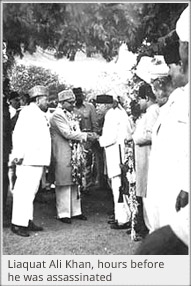
He died at the hands of an assassin on October 16. 1951 while addressing a public meeting at Rawalpindi and was buried in the courtyard of the Quaid-e-Azam's mausoleum.


Liaquat Ali Khan as Prime Minister
Liaquat Ali Khan’s contributions to the struggle for independence were numerous. After independence, he was thus the natural choice for the premiership. Liaquat Ali Khan was appointed as the first Prime Minister of Pakistan.
Being the first Prime Minister of the country, Liaquat Ali Khan had to deal with a number of difficulties that Pakistan faced in its early days. He helped Quaid-i-Azam in solving the riots and refugee problem and in setting up an effective administrative system for the country. He established the groundwork for Pakistan’s foreign policy. He also took steps towards the formulation of the constitution. He presented The Objectives Resolution, a prelude to future constitutions, in the Legislative Assembly. The house passed it on March 12, 1949. It is considered to be the “Magna Carta” in Pakistan’s constitutional history. Liaquat Ali Khan called it “the most important occasion in the life of this country, next in importance, only to the achievement of independence”. Under his leadership a team also drafted the first report of the Basic Principle Committee and work began on the second report.
During his tenure, India and Pakistan agreed to resolve the dispute of Kashmir in a peaceful manner through the efforts of the United Nations. According to this agreement a ceasefire was affected in Kashmir in January 1948. It was decided that a free and impartial plebiscite would be held under the supervision of the UN.
 
After the death of Quaid-i-Azam, he tried to fill the vacuum created by the departure of the Father of the Nation. The problem of religious minorities flared during late 1949 and early 1950, and it seemed as if India and Pakistan were about to fight their second war in the first three years of their independence. At this critical moment in the history of South Asia, Prime Minister Liaquat Ali Khan met Nehru to sign the Liaquat-Nehru Pact in 1950. The Liaquat-Nehru Pact was an effort on his part to improve relations and reduce tension between India and Pakistan. In May 1951, he visited the United States and set the course of Pakistan’s foreign policy towards closer ties with the West. An important event during his premiership was the establishment of National Bank of Pakistan in November 1949, and the installation of a paper currency mill in Karachi.
Liaquat Ali Khan was unfortunately assassinated on October 16, 1951. Security forces immediately shot the assassin, who was later identified as Saad Akbar. The question of who was behind his murder is yet to be answered.
The government officially gave Liaquat Ali Khan the title of Shaheed-i-Millat. 

 
00 01 02 03 04 05 06 07 08 09